Next cohort starts 8 September
The hidden link between your best month and your worst
For a lot of creative businesses, the busiest month is the one that causes the quiet one. Here’s why that swing happens, and what a steadier flow of work and income actually looks like in practice.
Think back to your best month this year. Not the most enjoyable one. The busiest. The one where the work stacked up, the days ran long, and you kept telling people you’d get back to them properly once things settled down. Now think about the month that turned up a few weeks later.
For a lot of creative businesses, those two months are joined at the hip, and it’s easy to miss how. The busy month sets the scene for the quiet one.
While you were head-down delivering, the steady work of finding what comes next went on the back burner. The emails, the conversations, the follow-ups you meant to send, all went on pause. Nobody decided to stop. There just wasn’t a spare hour. Then there wasn’t a spare week.
Think back to your best month this year. Not the most enjoyable one. The busiest. The one where the work stacked up, the days ran long, and you kept telling people you’d get back to them properly once things settled down. Now think about the month that turned up a few weeks later.
For a lot of creative businesses, those two months are joined at the hip, and it’s easy to miss how. The busy month sets the scene for the quiet one.
While you were head-down delivering, the steady work of finding what comes next went on the back burner. The emails, the conversations, the follow-ups you meant to send, all went on pause. Nobody decided to stop. There just wasn’t a spare hour. Then there wasn’t a spare week.
IN BRIEF
A steadier flow really comes down to five habits
Pick one thing to grow this quarter, lean on a few repeatable ways to win work, protect the time to do it, keep every lead in one place, and once a month get honest about what's working.

What you need to know
The busy month that leads to the quiet one
So, the work comes in, gets delivered brilliantly and goes out the door. Then there’s a Monday where you look at the weeks ahead and they’re sparser than you’d like.
The pipeline has trailed off and you’re starting the search for new work from cold.
None of this means you’re bad at running a business. Over years of working alongside creative businesses, it’s one of the most common patterns we see.
When you’re a small team, or a team of one plus the odd freelancer, delivery has to come first. Making sure your valued clients are kept happy is always the priority. As a result, marketing and business development become the things you'll get to later, and "later" keeps getting... well... later.
The catch is that the gap this creates doesn’t become clear until the work dries up. You can stop marketing and still feel busy for weeks. The work you’re focused on delivering masks the work you’re not winning. By the time your quiet month shows up, it's too late, because it started six or eight weeks earlier.
The pipeline has trailed off and you’re starting the search for new work from cold.
None of this means you’re bad at running a business. Over years of working alongside creative businesses, it’s one of the most common patterns we see.
When you’re a small team, or a team of one plus the odd freelancer, delivery has to come first. Making sure your valued clients are kept happy is always the priority. As a result, marketing and business development become the things you'll get to later, and "later" keeps getting... well... later.
The catch is that the gap this creates doesn’t become clear until the work dries up. You can stop marketing and still feel busy for weeks. The work you’re focused on delivering masks the work you’re not winning. By the time your quiet month shows up, it's too late, because it started six or eight weeks earlier.

Beyond word of mouth
New opportunities require new connections
For a good while, the work found you. A referral here, a repeat customer there, someone you met at a thing who remembered you months later. Your network was your main asset. It’s earned, and for a long time it’s genuinely enough.
Then the business grows. Your costs grow with it. The quiet stretches that were survivable when you were smaller start to bite in a way they didn’t before. And the same informal, word-of-mouth approach that carried you this far runs out of road. Not because you’ve done anything wrong. Because you’ve outgrown it. This is the point where most founders come to us. Not because they're in crisis, but because they can see that the way they secure new work hasn't kept pace with the business they're running today.
Then the business grows. Your costs grow with it. The quiet stretches that were survivable when you were smaller start to bite in a way they didn’t before. And the same informal, word-of-mouth approach that carried you this far runs out of road. Not because you’ve done anything wrong. Because you’ve outgrown it. This is the point where most founders come to us. Not because they're in crisis, but because they can see that the way they secure new work hasn't kept pace with the business they're running today.
What to keep in mind
Five habits that keep the work coming
When the quiet month bites, the natural response is to hurl yourself at marketing. A burst of posts, a flurry of emails, a scramble to line something up fast. And it sort of works, until the next project lands and your outreach efforts stop dead again.
Which is the actual problem. Not too little marketing. Too little consistency.
A steadier rhythm isn’t about becoming a content machine or living on every platform. It’s about doing a small amount that keeps going. Over the years we’ve heard some great tips and advice from our business mentors. We’ve pulled together five simple changes that can make a surprisingly big difference:
Which is the actual problem. Not too little marketing. Too little consistency.
A steadier rhythm isn’t about becoming a content machine or living on every platform. It’s about doing a small amount that keeps going. Over the years we’ve heard some great tips and advice from our business mentors. We’ve pulled together five simple changes that can make a surprisingly big difference:
01
Pick one thing to grow this quarter. Not everything. The kind of work, the kind of customer, or the corner of the business you most want more of.
02
Lean on a few routes you can actually repeat. That might be past clients, a couple of partnerships and one public channel you commit to. Three routes you consistently invest in will outperform ten you only dip into.
03
Protect your time before the week swallows it. Put it in the diary like a client deadline, because that’s effectively what it is. Even a couple of hours is plenty, as long as they actually happen.
04
Keep one source of truth. Every conversation, introduction and “let’s pick this up later” in one place, not scattered across your memory and three inboxes. When you’re flat out, memory is not a system.
05
Once a month, be honest about what’s working. Ten minutes to notice what’s bringing in interest and income, and what’s quietly eating time and giving little back. Keep the first, drop the second.
None of this is glamorous, and that’s the point. It’s small enough to survive a brutal month, and it keeps ticking when a big, dramatic push wouldn’t. Kept up across months, it’s the difference between a pipeline and a panic.
Working out where your business is actually losing the thread is exactly what the Growth Scorecard is built for, and it takes about two minutes.
Working out where your business is actually losing the thread is exactly what the Growth Scorecard is built for, and it takes about two minutes.

Growth Scorecard
See where your growth is getting stuck
Take the free Growth Scorecard. Ten quick questions, two minutes, no email needed to see your result
Take the Growth Scorecard nowGet it right
Not just more work. The right work.
There’s a second thing a steadier flow buys you, and it might matter more than volume. When work only arrives in bursts, you take what’s in front of you. The project that isn’t quite right. The customer who wants it faster and cheaper. The job you’d have politely turned down in a better month. That stop-start rhythm pushes you towards whatever fills the gap fastest, which is rarely your best work or your best margin.
When the flow is steadier, you get to be a little choosier. Better-matched work. Customers who value what you actually do. The higher-value projects, or the better-fit orders, that you never had the breathing space to chase because you were always catching up.
A lot of that comes down to being known for something specific rather than being available for anything. The clearer you are about the work you want more of, the sooner the right customers recognise themselves in your message, and the lighter your marketing has to work.
Steadier isn’t only calmer. Over time, it tends to be more profitable, because you stop making your biggest decisions from the back foot.
When the flow is steadier, you get to be a little choosier. Better-matched work. Customers who value what you actually do. The higher-value projects, or the better-fit orders, that you never had the breathing space to chase because you were always catching up.
A lot of that comes down to being known for something specific rather than being available for anything. The clearer you are about the work you want more of, the sooner the right customers recognise themselves in your message, and the lighter your marketing has to work.
Steadier isn’t only calmer. Over time, it tends to be more profitable, because you stop making your biggest decisions from the back foot.

The Gaps
Where are the gaps in your strategy?
Knowing that busy-then-quiet swing happens isn't the same as knowing where your version of it is going wrong, and every business has holes somewhere different.
For some, it really is the pipeline. For others, the pipeline is fine and the real drag sits elsewhere: pricing that hasn’t moved in three years, capacity that’s maxed out, or a business where every decision still routes back through the founder. More marketing won’t fix slow follow-up, and a full diary won’t fix small margins. Put your effort into the wrong one and you spend the scarcest thing you’ve got, your own time, fixing something that was never the problem.
That’s exactly what the Growth Scorecard can help you get a better understanding of.
For some, it really is the pipeline. For others, the pipeline is fine and the real drag sits elsewhere: pricing that hasn’t moved in three years, capacity that’s maxed out, or a business where every decision still routes back through the founder. More marketing won’t fix slow follow-up, and a full diary won’t fix small margins. Put your effort into the wrong one and you spend the scarcest thing you’ve got, your own time, fixing something that was never the problem.
That’s exactly what the Growth Scorecard can help you get a better understanding of.
Free · No sign-up · 2 minutes
The Growth Scorecard
- Ten quick questions, done in under two minutes.
- No email needed to see your result.
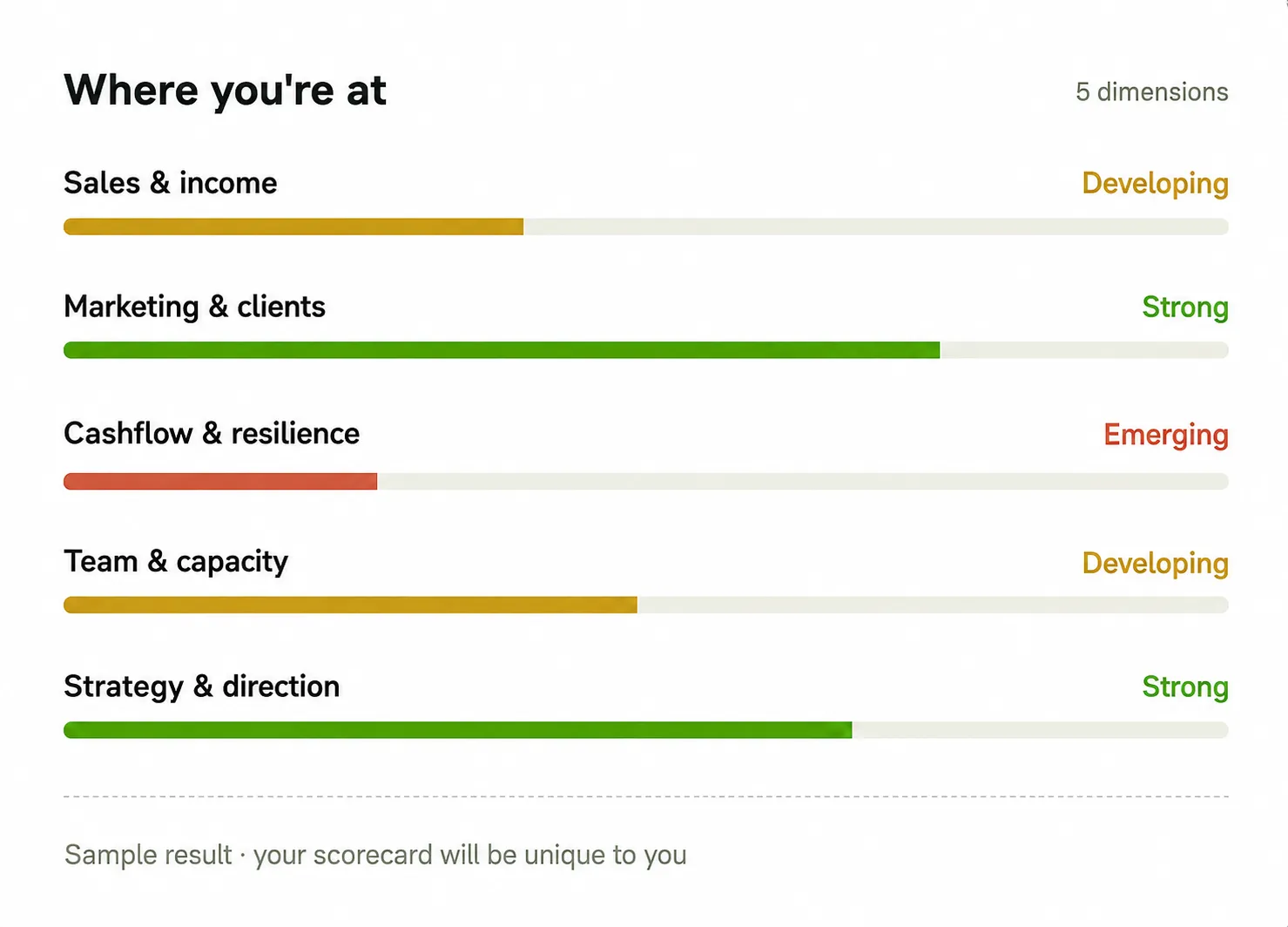
- An honest read across the five areas that shape how a creative business grows: strategy and direction, marketing and income, your team or capacity, your own resilience, and the practical business basics.
- Your single biggest growth opportunity, named.
- A clear pointer to what to focus on next, and the part of the GrowthCamp programme built to help with it.
Re:Create GrowthCamp
When you’d rather not work it out alone
Your Growth Scorecard highlights the areas of your business that need the most attention. Turning those insights into action is where support can make all the difference. That's what Re:Create GrowthCamp is designed to help with.
Recognising what needs to change is the first step. Turning those insights into action is where support can make all the difference. That’s what Re:Create GrowthCamp is designed to help with.
It’s a 12-week programme from Creative United that gives you direct access to decades of real-world experience across branding, international entertainment, arts and heritage, and scaling consumer businesses. The people you’ll work with have built the fashion label, represented the artists and grown the heritage organisation. They understand your industry because they’ve spent their careers in it.
Recognising what needs to change is the first step. Turning those insights into action is where support can make all the difference. That’s what Re:Create GrowthCamp is designed to help with.
It’s a 12-week programme from Creative United that gives you direct access to decades of real-world experience across branding, international entertainment, arts and heritage, and scaling consumer businesses. The people you’ll work with have built the fashion label, represented the artists and grown the heritage organisation. They understand your industry because they’ve spent their careers in it.
How it works
- A cohort of up to 12 creative business owners and senior leaders, so nobody gets lost in the room.
- 21 hours of support across the 12 weeks: group workshops and one-to-one sessions, online and in person at Somerset House in central London
Including: Five hours of business mentoring with an expert matched to your creative business, scheduled around your work rather than against it. - Practical ground to cover: sales and income, winning the right customers, cashflow and financial resilience, growing a team, and a growth plan built around your business rather than a template.
It builds on Re:Create, the programme that has supported more than 200 creative businesses across London and Essex since 2021.
Places are limited and cohorts are small by design, so it’s worth a look before they fill.
Learn more about Re:Create GrowthCamp
See how the programme works, meet the mentors, and check the dates.

Free · No sign-up · 2 minutes
Start with two minutes
You didn’t build a creative business to spend your good months dreading the quiet ones. A steadier flow of work, and the steadier income that comes with it, is far more achievable than it feels when you’re in the middle of a busy stretch.
It rarely comes from one big breakthrough. More often, it’s finding the right gap, building a small rhythm around it, and keeping that rhythm alive when the work gets busy again.
Whether you tackle that on your own or with a bit of expert company, it starts the same way: seeing the gap clearly. That only takes two minutes
It rarely comes from one big breakthrough. More often, it’s finding the right gap, building a small rhythm around it, and keeping that rhythm alive when the work gets busy again.
Whether you tackle that on your own or with a bit of expert company, it starts the same way: seeing the gap clearly. That only takes two minutes
See where your growth is getting stuck. Take the free Growth Scorecard.
Ten quick questions. Two minutes. No email needed to see your result.
Take the free Growth Scorecard